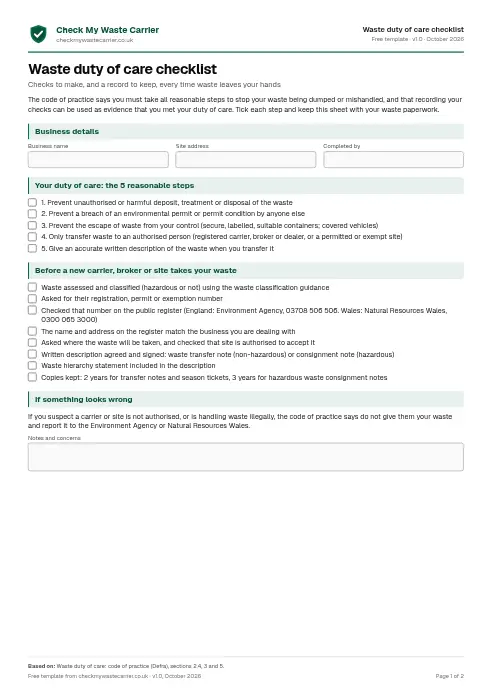
The 5 reasonable steps
The code of practice says waste holders must take all reasonable steps to:
- prevent unauthorised or harmful deposit, treatment or disposal of waste
- prevent a breach of an environmental permit, or of a permit condition, by anyone else
- prevent the escape of waste from your control
- make sure anyone you transfer waste to has the correct authorisation
- provide an accurate description of the waste when you transfer it
Your duty does not end at the gate. You are expected to take reasonable steps to make sure the waste is managed correctly throughout its journey: check the next holder is authorised, ask where they are taking it and check that destination is authorised, and make more detailed checks if you suspect something is wrong.
How to use the checklist
- Classify the waste. Work out whether it is hazardous using the waste classification guidance. That decides which paperwork you need.
- Ask for their number. Ask the carrier, broker or dealer for their registration number, or the receiving site for its permit or exemption.
- Check it on the register. Look the number up on the public register and make sure the name and address match the business in front of you.
- Ask where it is going. Ask where the waste will be taken, and check that site is authorised to accept it.
- Describe it in writing. Complete a waste transfer note (non-hazardous) or consignment note (hazardous), signed by both of you.
- Log the check and keep it. Record what you checked on the log and keep it with your transfer notes.
Checking a carrier properly
An authorised person is someone with a valid registration as a waste carrier, broker or dealer, or a waste site operator with an environmental permit or registered exemption to accept that waste. The code of practice says you can ask for evidence, such as a copy of their registration, and should use the public register to check it. In England that is the Environment Agency register (or call 03708 506 506); in Wales, Natural Resources Wales (0300 065 3000).
Look for the obvious mismatches: a name on the register that does not match the van or the invoice, a registration that has expired, or a lower tier registration for a firm collecting other people's waste. See upper vs lower tier and how to check a waste carrier in 3 steps.
Describing the waste and keeping records
For non-hazardous waste, the written description is usually a waste transfer note, kept for 2 years. Hazardous waste needs a consignment note, kept for 3 years. Before waste is collected you must assess and classify it, store it in suitable, labelled containers and stop it escaping, for example by making sure vehicles are covered.
Running a duty of care waste audit
A duty of care audit sounds heavier than it is. It means stepping back from the day-to-day bin lifts and asking one question: if someone asked tomorrow where our waste went and who took it, could we show them? The code of practice does not set out a formal audit procedure. The word appears once, where it says it is best practice to keep a record of waste moved between your own premises for audit purposes. So treat an audit as running the same checks again, on everything you hand over, and writing down what you found.
Work through these, using the log on page 2 of the checklist:
- List every waste stream and every collector. General waste, recycling, hazardous waste, one-off clear-outs and skips. Include the small jobs, such as a builder taking away old fittings.
- Re-check each registration on the public register. A registration you checked when the contract started can lapse or change. Confirm the name and number still match the firm on your invoices and the vehicle that turns up.
- Ask where the waste is taken. The code of practice says to ask the next holder where they are taking your waste and check that the site is authorised to accept it.
- Match the paperwork to the waste. Each stream should have a waste transfer note or season ticket with a schedule (kept 2 years), or a consignment note for hazardous waste (kept 3 years). Check the description still matches what you actually throw away.
- Look for gaps and act on them. If something does not add up, the code of practice says carry out more detailed checks, for example asking for evidence that your waste arrived at the intended site and was accurately described.
Date the log, note who carried out the checks and keep it with your transfer notes. It is the record that shows you took reasonable steps if a load is ever traced back to you.
If you are a householder
Householders have a narrower duty: take all reasonable measures to give household waste only to an authorised person. If you use a private firm, such as skip hire or house clearance, check they hold an up-to-date upper tier registration, which in England starts CBDU. There is no legal requirement to keep records, but the code of practice suggests they can quickly show you met your duty if your waste is fly-tipped: the registration number, a receipt with the business details, a photo of their registration, or the vehicle registration, make, model and colour. Page 2 of the checklist has a box for exactly this. Councils can issue a fixed penalty of up to £600 to householders who fail their duty (GOV.UK).
If something does not look right
If you suspect a carrier or site is not authorised, or is handling waste illegally, the code of practice says do not give them your waste and report it to the Environment Agency or Natural Resources Wales. Already had waste dumped? See what to do if a carrier fly-tips your waste.
Questions
What is the waste duty of care?
A legal duty on anyone who produces, imports, carries, keeps, treats or disposes of controlled waste, or controls it as a dealer or broker, to take all reasonable steps to make sure it is managed properly from the moment it is produced to its final recovery or disposal.
Who does the duty of care apply to?
Businesses such as shops, offices, factories and tradespeople, public services such as schools and hospitals, charities and community groups, and waste businesses themselves. Householders have a separate, narrower duty for household waste from their own home.
What happens if I do not meet it?
Failing to comply with the duty of care is a criminal offence. For businesses there is no upper limit on the fine a court can impose, and in some cases a fixed penalty notice may be offered instead of prosecution.
Do I have to keep a record of my checks?
The code of practice says to record any checks you make, as you can use this as evidence that you met your duty of care. For householders there is no legal requirement to keep records, but they can quickly show you met your duty if your waste is later fly-tipped.
How do I check a waste carrier licence?
Ask for their registration number (in England it starts CBDU for upper tier or CBDL for lower tier) and check it on the public register. You can search the register here by name, number or postcode.
What is a duty of care waste audit?
A review of how your business hands over its waste: every waste stream, who collects it, whether their registration is still valid, where the waste goes and whether your transfer or consignment notes are complete. The code of practice does not prescribe a format, so record what you checked, when and who did it.
How often should I audit my waste duty of care?
The code of practice does not set a frequency. A sensible point is whenever a season ticket comes up for renewal (it covers up to a year), when you change collector or start producing a new type of waste, and straight away if you suspect waste is not being handled properly.
What should I do if I think a carrier is not legitimate?
Do not give them your waste. The code of practice says to report suspected illegal activity to the Environment Agency in England or Natural Resources Wales in Wales.
Get quotes from registered carriers Waste transfer note template