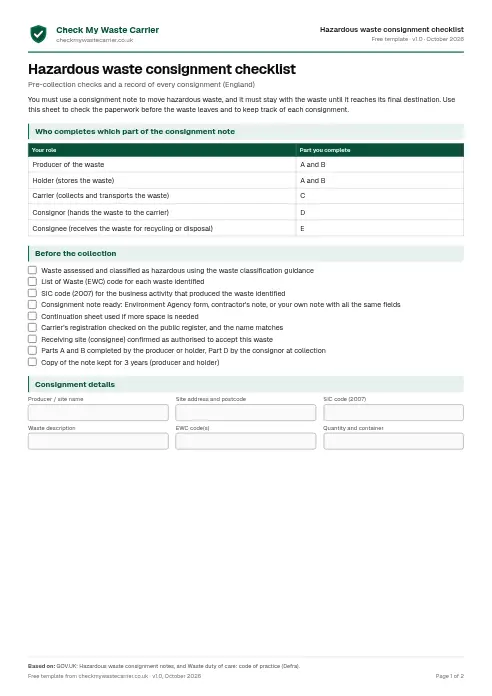
Hazardous waste paperwork can feel built to trip you up: a form with five parts, codes you may never have heard of, and a note that has to travel with the waste. Once you know which part is yours and what to check before the lorry arrives, it is far more manageable. This page sets it out, and the free checklist keeps a record of every consignment.
Short answer: a hazardous waste consignment note (HWCN) must travel with hazardous waste every time it moves, until it reaches its final destination. The producer or holder fills in Parts A and B, keeps one copy and gives 2 to the carrier. Producers and holders keep their records for 3 years at the premises where the waste was produced or stored (GOV.UK).
Summary of official guidance, not legal advice. From GOV.UK: hazardous waste consignment notes, the Environment Agency consignment note form and the waste duty of care code of practice. For England. Our checklist is not a consignment note.
When you need one
GOV.UK says you must use consignment notes to move hazardous waste, and a consignment note must stay with the waste until it reaches its final destination. The code of practice says this applies to all movements of hazardous waste, including collections by registered carriers, movements between premises belonging to the same business, and all movements from the producer's premises.
It lists only two exceptions: domestic hazardous waste removed from a household, other than asbestos waste, and waste imported or exported under international shipment controls, which use an equivalent note. So asbestos removed from a home still needs a consignment note.
Who completes which part
| Your role | Part you complete |
|---|
| Producer of the waste | A and B |
| Holder (stores the waste) | A and B |
| Carrier (collects and transports the waste) | C |
| Consignor (hands the waste to the carrier) | D |
| Consignee (receives waste for recycling or disposal) | E |
If you are the producer or holder you will need two codes: the Standard Industrial Classification (SIC) 2007 code for the business activity that produced the waste, and the waste classification code (List of Waste or EWC code) for the waste itself (GOV.UK).
Step by step
- Confirm the waste is hazardous. Assess and classify the waste using the waste classification guidance, and note the List of Waste (EWC) code.
- Find your SIC code. Look up the Standard Industrial Classification (SIC) 2007 code for the business activity that produced the waste.
- Get a consignment note. Download the Environment Agency form, use your contractor's note, or write your own with all the same information fields.
- Complete your part. Producers and holders complete Parts A and B; the carrier completes Part C; the consignor Part D; the consignee Part E.
- Check the carrier and the destination. Check the carrier's registration on the public register and confirm the receiving site can accept the waste.
- Keep your copy for 3 years. The note travels with the waste to its destination. Producers and holders keep their copy for 3 years. Log it on the checklist.
Where to get a consignment note
- Download the Environment Agency form from GOV.UK, fill in the parts that apply to you, and use a continuation sheet if you need more space.
- Use a note from your waste contractor.
- Write your own. GOV.UK says it must have all the same information fields as the official form and be as near to the same format as possible.
- Buy printed, colour-coded 3-copy notes from the Environment Agency.
Our checklist does not replace any of these. It makes sure the note is right before the waste goes, and gives you one place to log each consignment.
Where the copies go
Notes bought from the Environment Agency come with 3 colour-coded copies, and GOV.UK describes the hand-offs like this:
- Producer or holder: completes Parts A and B, keeps one copy and gives 2 copies to the carrier collecting the waste (GOV.UK).
- Carrier: checks Parts A and B and the waste before accepting it, completes Part C, and keeps 2 copies with the waste until it reaches the destination on the note, which must be an authorised site (GOV.UK).
- Consignee (receiving site): must reject the waste if the note is missing, incorrect or incomplete, completes Part E for anything it accepts or rejects, keeps one copy and hands one back to the carrier (GOV.UK).
How long to keep it
GOV.UK calls these records a register. How long you keep it depends on your role:
| Who | How long | Where |
|---|
| Producer or holder | 3 years | At the premises that produced or stored the waste |
| Carrier | 1 year | At the head office |
| Waste dealer or broker | 3 years (copies of the producer's or holder's records) | Not specified |
| Receiving site with a permit (not landfill) | Consignment notes 5 years | At the site |
| Landfill site | As long as it holds a permit | At the site |
| Site with an exemption | 3 years | At the site |
As a producer or holder, your register is more than the notes: keep the consignee returns you receive and any related documents, such as carrier schedules (a list of carriers when there is more than one) and records of rejected loads. If a document is inaccurate or incomplete, keep a record of the missing information (GOV.UK).
Consignee returns: the receipt that closes the loop
The site that receives your waste must send consignee returns every quarter, separately to the Environment Agency and to you. If yours do not arrive, GOV.UK says ask for them in writing, and contact the Environment Agency and stop using a waste business that does not provide them (GOV.UK). Keep each return with the consignment note it relates to.
Chain of custody: from collection to disposal
When hazardous waste leaves your site, the worry is simple: if it turns up somewhere it should not, can you prove where it went? For hazardous waste in England, the consignment note system is your chain of custody. Each party signs for the waste in turn, and the paperwork comes back to you at the end.
| Stage | What happens | Your evidence |
|---|
| Before collection | The note is prepared before the waste moves (GOV.UK); producer or holder completes Parts A and B | Your note, with the waste description and codes |
| Collection | Carrier checks the waste against the note and completes Part C; the consignor completes Part D | Your copy, kept at your premises |
| Transport | 2 copies travel with the waste to the authorised site named on the note | The carrier's registration, checked on the register |
| Arrival | Receiving site accepts or rejects the waste and completes Part E | The site's permit, checked before you book |
| After disposal | Receiving site sends consignee returns every quarter, to you and to the Environment Agency | The returns, filed with the note they relate to |
A gap anywhere in that chain is a gap in your evidence. GOV.UK says producers and holders must keep a record of any missing information if a document is inaccurate or incomplete (GOV.UK), and if the receiving site turns your waste away, there is separate guidance on rejected loads.
Asbestos waste consignment notes
Asbestos is where most people first meet a consignment note. HSE guidance (EM9: disposal of asbestos waste) says asbestos waste is hazardous waste in England and Wales when it contains more than 0.1% asbestos. It says to complete a hazardous waste consignment note, keep copies for 3 years, use a registered waste carrier if you are not carrying it yourself, use a licensed disposal site, and never mix asbestos waste with other waste to get it below 0.1%.
Asbestos from a home is the exception to the household rule. GOV.UK says a contractor who produces asbestos waste at a home, or is employed by the householder to collect it, must consign it, complete the note as the waste producer, and enter their business name and the address of the home in Part A2 (GOV.UK). If you are the householder, the note is the contractor's job, but check their registration on the register before they start.
Consignment note or waste transfer note?
| Hazardous waste consignment note | Waste transfer note |
|---|
| Used for | Hazardous waste, every movement | Non-hazardous waste |
| Producer keeps it | 3 years | 2 years |
| One note for a year of collections | No, a note goes with each movement | Yes, a season ticket can cover up to a year |
Searching for a "hazardous waste transfer note"? The document you need is the consignment note. A standard waste transfer note does not cover hazardous waste.
Digital waste tracking
Since 1 October 2026, permitted receiving sites in England and Wales report waste they receive through a digital service. GOV.UK says consignment notes must still be completed alongside it until further notice, and that a load arriving with several consignment notes is entered separately for each note (GOV.UK).
Check the carrier first
A perfect consignment note will not help if the carrier is not authorised. Check their registration on the public register and make sure the receiving site can accept the waste. See the duty of care checklist.
Questions
What is a hazardous waste consignment note?
The document that must go with hazardous waste every time it is moved, from the producer's premises to its final destination. Each person in the chain completes their part.
What does HWCN stand for?
Hazardous waste consignment note. It is the same document, sometimes also called a hazardous waste transfer note or a consignment notice.
How long should you keep a hazardous waste consignment note?
It depends on your role. GOV.UK says producers and holders keep their records for 3 years at the premises that produced or stored the waste, and carriers keep theirs for 1 year at their head office. Permitted receiving sites keep consignment notes for 5 years, landfill sites keep records for as long as they hold a permit, and exempt sites keep them for 3 years (GOV.UK).
How many copies of a consignment note are there?
The Environment Agency sells notes with 3 colour-coded copies. The producer or holder keeps one and gives 2 to the carrier, which travel with the waste. The receiving site completes Part E, keeps one and hands one back to the carrier.
Is a hazardous waste transfer note the same as a consignment note?
People often use the name, but the legal document for hazardous waste is the consignment note. A standard waste transfer note is only for non-hazardous waste and is kept for 2 years, not 3.
What is the chain of custody for hazardous waste?
The paper trail that shows where your waste went, from your premises to the site that accepted it. For hazardous waste in England it is built from the consignment note (Parts A to E, filled in by each party in turn), your copy of it, and the consignee returns the receiving site sends you each quarter. Keep them together for 3 years (GOV.UK).
Do you need a consignment note for asbestos waste?
Yes. HSE says asbestos waste is hazardous waste in England and Wales when it contains more than 0.1% asbestos, and a hazardous waste consignment note must be completed (HSE EM9). Asbestos is also the one household hazardous waste that still needs a note: a contractor who removes it from a home completes the note as the producer (GOV.UK).
What are consignee returns?
Quarterly reports from the site that received your hazardous waste. GOV.UK says producers and holders should get one every quarter, ask in writing if they do not, and contact the Environment Agency and stop using a waste business that does not provide them (GOV.UK).
Can I write my own consignment note?
Yes. GOV.UK says you can use a note from your waste contractor or write your own, but it must include all the information on the official form and be as near to the same format as possible (GOV.UK).
Do householders need a consignment note?
Domestic hazardous waste removed from a household does not need one, with one important exception in the code of practice: asbestos waste. Asbestos removed from a home still needs a consignment note.
Where do I get printed consignment notes?
Buy colour-coded 3-copy notes from the Environment Agency, use the notes your waste contractor supplies, download the form from GOV.UK and fill it in, or write your own with the same information fields.
Does digital waste tracking replace consignment notes?
Not yet. GOV.UK says consignment notes must still be completed alongside the digital service until further notice, and a receiving site enters the waste on each consignment note as a separate entry (GOV.UK).
Get quotes from registered carriers Non-hazardous: waste transfer note template